
How to Trust Yourself in a Relationship When You're Second-Guessing Everything
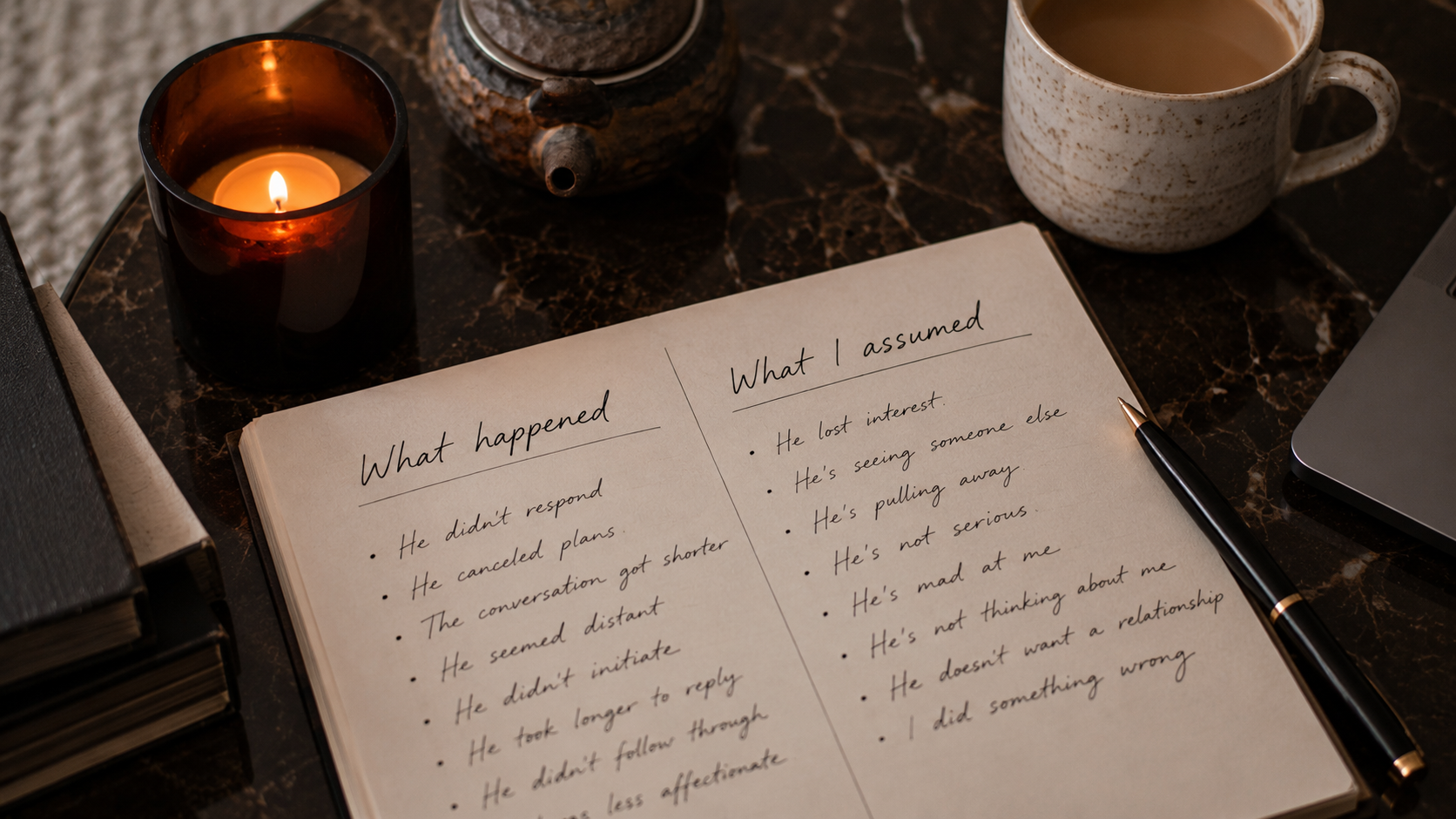
You can be decisive at work, manage a household, solve complicated problems, and still find yourself asking six friends what to make of a message that says, “Sorry, been busy.” Relationship uncertainty has a way of making perfectly competent people question their own judgment. Add affection, history, and the possibility of losing someone, and suddenly even your own observations feel negotiable.
To trust yourself in a relationship, start by separating what you know from what you're interpreting and what you want to be true. Then look for consistent patterns, clarify your standards, and make decisions based on the information available rather than waiting for absolute certainty. Self-trust grows through the experience of taking your own observations seriously and following through on choices you can explain to yourself.
Why you may keep doubting your relationship judgment
Sometimes uncertainty is appropriate. You're getting to know someone, the circumstances are changing, or you have incomplete information. Good judgment makes room for what it doesn't yet know.
Other times you already have a reasonable understanding of what is happening, but accepting it would require a choice you don't want to make. You might need to initiate a difficult conversation, stop extending a benefit of the doubt, or acknowledge that the relationship is pleasant in certain moments but disappointing in the ways that matter most to you.
There is also the possibility that your confidence has been eroded by repeated dismissal, broken agreements, or attempts to make you question your own experience. If someone regularly denies obvious events, mocks your concerns, or punishes you for bringing up a problem, the issue cannot be solved through better journaling alone. The relationship conditions themselves deserve examination, and safety may need to come first.
Start with the distinction that changes everything: facts, interpretation, preference
Take one situation that has been bothering you and write three short entries.
What happened: “We agreed to see each other Saturday. They canceled an hour before and didn't suggest another time.”
What I'm interpreting: “I'm not important to them.”
What I want or need: “I want to date someone who follows through and makes an effort to reschedule when plans fall apart.”
The first entry can be checked. The second is an interpretation that could be right, wrong, or incomplete. The third describes your requirement, which remains legitimate regardless of whether the other person had a perfectly reasonable explanation for canceling.
This exercise stops two familiar mistakes. One is treating every uncomfortable feeling as proof of another person's intentions. The other is demanding certainty about their intentions before you're allowed to acknowledge that a dynamic isn't working for you.
Look at patterns instead of litigating individual moments
One late reply tells you very little. A persistent combination of broken commitments, avoidance, and affection that only appears when it's convenient tells you considerably more. Context matters, including work demands, caregiving responsibilities, health, communication preferences, and the agreements you actually made together.
Ask yourself what the pattern looks like over a period long enough to be meaningful. Do the words and actions generally correspond? When a concern is raised, is there curiosity and reasonable effort, or does the conversation end with you apologizing for having mentioned it? If someone makes a change, can you observe it over time rather than being asked to consider the promise itself sufficient?
These are questions about behavior, which is information you can evaluate. The person may have sincere feelings for you and still be unable or unwilling to build the kind of relationship you want. Your decision doesn't require proving their affection is fake.
Put your intuition in conversation with evidence
I work with intuition professionally, and I'm also a firm believer in questioning what we think we know. A strong inner impression can be useful because it draws your attention to something. It should not be granted immunity from further examination simply because it arrived with conviction.
The American Psychological Association defines intuition as immediate insight or perception, distinguished from conscious reasoning. The National Academies' decision-making guide likewise explains that quick judgments can be useful, especially with experience, but can also be distorted by bias. Neither observation requires you to disregard intuition. They invite you to ask what might be informing it and what would help test the impression.
If your gut says something is off, write down what you noticed before building a case around it. Perhaps a question was repeatedly dodged, an agreement changed without discussion, or you felt pressured to accept intimacy faster than you wanted. Those are details worth examining. An unexplained sense of dread or certainty, on its own, may not tell you which conclusion is correct.
Practice making decisions before you have perfect reassurance
Choose the smallest decision that is actually yours to make. You might stop rearranging your week for plans that haven't been confirmed, ask for clarity about whether you're exclusive, or decide that repeated disrespect is enough reason to step away.
Before acting, answer four questions:
What do I know with reasonable confidence?
What remains uncertain, and can I clarify it directly and safely?
What standard or value is relevant to my choice?
What action am I willing to take if nothing changes?
Then pay attention to what happens after you act. Maybe the discussion goes well and gives you better information. Maybe someone refuses to engage. Maybe you discover you can tolerate another person's disappointment without retracting what you meant. Each outcome helps you build trust in your ability to respond to reality rather than endlessly rehearse hypothetical futures.
Self-trust doesn't mean never changing your mind
Sometimes new facts warrant a new decision. Changing your mind after receiving credible information can be good judgment. What undermines self-trust is repeatedly abandoning a considered decision simply because holding it feels uncomfortable or because another person dislikes it.
It's also possible to make a thoughtful decision and still feel sad about it. Missing someone isn't proof that leaving was a mistake. Feeling relief doesn't prove the relationship was worthless. People are rarely that tidy, and complex feelings don't cancel out the reasons behind your choice.
If your partner respects boundaries, participates in difficult conversations, and follows through over time, notice that too. Self-trust also includes allowing good evidence to revise an old fear. For practical questions about what emotional boundaries look like in a relationship, Love Is Respect provides a useful guide.
The question to ask when you're stuck
Try this: “If I stopped trying to predict how this person will respond, what decision would make sense from the information I already have?” You may discover that the next step is a conversation, a pause, a boundary, or an ending. The point is to identify the part that belongs to you and address it deliberately.
My private coaching work explores precisely this territory: the gap between what you recognize and what you're still participating in. If you're ready to look at the pattern, examine your decisions, and put your own judgment back in the room, private coaching may be an appropriate next step.
